
Free Prometric Claims Adjuster Practice Test: Sample Questions & Answers
Preparing for your insurance claims adjuster exam can feel overwhelming, especially when you are trying to figure out what Prometric will actually test you on. If you want to walk into that testing center with total confidence, taking a realistic Prometric claims adjuster practice test for free is your absolute best strategy.
Below is a massive collection of 50 core practice questions designed to boost your dwell time, test your knowledge of general insurance principles, and ensure you pass on your very first try.

Pro Tip: Do not just rush through these questions. Read the detailed explanations for every correct choice. If you want to explore more topics, check out our previously published guide on Real Estate Exam Practice Questions Test Guide
📥 Free Downloadable PDF Resource
Want to study offline? Download our complete study guide and cheat sheet bundle:
Download Free Practice Test PDFSection 1: General Insurance Principles & Concepts (Q1 – Q15)
Let us start with foundational insurance laws, risk management terms, and policy structures to master your free preparation for the ProMetric Claims Adjuster practice test.
Question 1: What does an independent insurance adjuster do?
A) Works exclusively for one insurance company as a direct employee.
B) Represents the policyholder in court against insurance firms.
C) Is an independent contractor who handles claims for multiple insurance companies.
D) Sells new insurance policies to high-risk commercial clients.
Correct Answer: C
Explanation: An independent adjuster is self-employed or works for an adjustment firm, handling claims for various insurance carriers on a contract basis. Check out our Claims Adjuster Practice Exams for more core definitions.
Question 2: Which type of property insurance policy covers a broader range of perils?
A) Basic Form (DP-1)
B) Broad Form (DP-2)
C) Named Perils Policy
D) Limited Fire Policy
Correct Answer: B
Explanation: The Broad Form (DP-2) covers more named perils than the basic Form, including additional items like weight of ice and freezing of plumbing systems.
Question 3: In insurance terms, what is “indemnity”?
A) Punishing the at-fault party with heavy cash fines.
B) Restoring the insured to the exact financial place they were before the loss.
C) Paying out double the policy limit for emotional stress.
D) Transferring all risk away from the insurance carrier.
Correct Answer: B
Explanation: The principle of indemnity means the insurance payout restores you financially, without letting you profit from a loss.
Question 4: What is a “binder” in insurance contracts?
A) A permanent legal policy document.
B) Temporary proof of insurance coverage issued before the policy is officially written.
C) A financial penalty for late premium payments.
D) An agreement to cancel a claim.
Correct Answer: B
Explanation: A binder provides temporary insurance coverage until the insurer evaluates the application and issues the formal policy.
Question 5: What is “subrogation”?
A) The right of the insurer to pursue a third party that caused a loss to recover paid claims.
B) Canceling a policy due to non-payment.
C) Increasing the deductible after an accident.
D) Transferring property ownership.
Correct Answer: A
Explanation: Subrogation allows the insurance company to step into the insured’s shoes to recover payout costs from the responsible party.
Question 6: Which hazard is described as an intentional act or dishonesty by the insured?
A) Physical hazard
B) Moral hazard
C) Morale hazard
D) Legal hazard
Correct Answer: B
Explanation: Moral hazard involves dishonest tendencies or intentional illegal acts by the insured party.
Question 7: What does “proximate cause” mean in insurance claims?
A) The final cost of repairs.
B) An unbroken chain of events between the occurrence of a covered peril and the resulting damage.
C) The closest insurance office location.
D) The date a claim is filed.
Correct Answer: B
Explanation: Proximate cause is the primary, active cause that sets an unbroken chain of events into motion resulting in loss.
Question 8: What is an insurance deductible?
A) The maximum amount the insurance company will pay out.
B) The monthly cost of the insurance policy.
C) The out-of-pocket amount the insured must pay before insurance coverage kicks in.
D) A government tax on insurance claims.
Correct Answer: C
Explanation: The deductible is the initial portion of a loss that the policyholder agrees to pay themselves.
Question 9: Which term refers to the failure to disclose a material fact?
A) Waiver
B) Estoppel
C) Concealment
D) Rebating
Correct Answer: C
Explanation: Concealment is deliberately hiding a material fact that could affect policy issuance or claim validity.
Question 10: What is “estoppel”?
A) A legal ban stopping a party from reasserting a right that they previously waived.
B) The process of calculating property depreciation.
C) Canceling an insurance license.
D) Issuing a temporary policy binder.
Correct Answer: A
Explanation: Estoppel prevents someone from claiming a right if their previous words or actions led someone else to rely on them.
Question 11: What is open perils coverage?
A) Coverage only for fire and wind.
B) Coverage for all losses except those specifically excluded in the policy.
C) Coverage that has no deductible.
D) Coverage that only applies to commercial buildings.
Correct Answer: B
Explanation: Open perils (or all-risk) policies cover any cause of loss unless it is specifically excluded in the contract text.
Question 12: What does “actual cash value” (ACV) mean?
A) The cost to buy a brand-new item today.
B) Replacement cost minus physical depreciation.
C) The original purchase price paid years ago.
D) The market value of land.
Correct Answer: B
Explanation: ACV calculates value by taking current replacement cost and subtracting wear, tear, and depreciation.
Question 13: What is replacement cost?
A) The cost to replace damaged property with new property of like kind and quality without depreciation deduction.
B) The value of property after a fire.
C) The salvage value of wreckage.
D) The bank loan value.
Correct Answer: A
Explanation: Replacement cost pays the full cost to repair or replace items new without accounting for age or depreciation.
Question 14: What is a morale hazard?
A) An intentional lie on an application.
B) Carelessness or indifference of a person because they have insurance coverage.
C) Physical weakness in a building structure.
D) Strict state laws.
Correct Answer: B
Explanation: Morale hazard arises from an indifferent attitude, such as leaving doors unlocked because “insurance will pay for it.”
Question 15: What is a physical hazard?
A) Dishonesty of an employee.
B) A physical condition that increases the probability of a loss, such as icy steps or frayed wiring.
C) Careless driving habits.
D) Financial bankruptcy.
Correct Answer: B
Explanation: Physical hazards are tangible environmental or structural conditions that increase the likelihood of damage or injury.

Section 2: Dwelling & Homeowners Policy Practice Questions (Q16 – Q30)
Property coverage forms are heavily tested on Prometric adjuster exams. Let us test your knowledge on DP-1, DP-2, DP-3, and HO forms.
Question 16: Which dwelling form is a named perils policy that provides basic coverage on both dwelling and personal property?
A) DP-1 (Basic Form)
B) DP-2 (Broad Form)
C) DP-3 (Special Form)
D) HO-3 Form
Correct Answer: A
Explanation: DP-1 is the basic form covering limited named perils (like fire, lightning, and internal explosion) on an ACV basis.
Question 17: Under a DP-3 Special Form dwelling policy, how is coverage structured for the dwelling structure?
A) Named perils only
B) Open perils (risks of direct physical loss)
C) Actual cash value only
D) Liability only
Correct Answer: B
Explanation: DP-3 provides open perils coverage for the dwelling and structures, while personal property remains covered on a named perils basis.
Question 18: What does Homeowners Form HO-3 provide?
A) Broad form coverage for dwelling and contents.
B) Open perils coverage for dwelling and structures, and named perils for personal property.
C) Renter’s insurance only.
D) Condominium unit owner coverage.
Correct Answer: B
Explanation: HO-3 is the standard special form policy offering open perils on real property (dwelling) and named perils on personal property.
Question 19: Which homeowners form is designed specifically for renters?
A) HO-2
B) HO-4
C) HO-6
D) HO-8
Correct Answer: B
Explanation: HO-4 (Contents Broad Form) is tailored for tenants/renters to cover personal property and liability.
Question 20: Which homeowners form is designed for condominium unit owners?
A) HO-3
B) HO-5
C) HO-6
D) HO-8
Correct Answer: C
Explanation: HO-6 (Unit Owners Form) covers personal property and interior alterations for condo owners.
Question 21: What is covered under Section II of a standard homeowners policy?
A) Dwelling property damage
B) Personal liability and medical payments to others
C) Flood damage
D) Earthquake losses
Correct Answer: B
Explanation: Section I covers property, while Section II of a homeowners policy focuses exclusively on personal liability and medical payments.
Question 22: Are flood losses covered under a standard DP-3 or HO-3 policy?
A) Yes, fully covered.
B) No, flood is an excluded peril in standard property policies.
C) Covered only up to $1,000.
D) Covered if it rains for more than 3 days.
Correct Answer: B
Explanation: Surface water and floods are strictly excluded under standard property forms and require a separate National Flood Insurance Program (NFIP) policy.
Question 23: What does Coverage C protect in a homeowners policy?
A) Other structures (detached garage)
B) Personal property of the insured
C) Loss of use/living expenses
D) Medical payments
Correct Answer: B
Explanation: Coverage C protects personal property owned or used by the insured anywhere in the world.
Question 24: What does Coverage D cover in dwelling and homeowners forms?
A) Direct physical damage to walls
B) Fair rental value and loss of use
C) Legal defense fees
D) Theft of jewelry
Correct Answer: B
Explanation: Coverage D handles loss of use and additional living expenses when a home becomes uninhabitable due to a covered loss.
Question 25: What is the typical grace period or notice requirement for policy cancellation due to non-payment of premium?
A) 3 days
B) 10 days written notice
C) 60 days’ notice
D) 1 year
Correct Answer: B
Explanation: Insurers generally must provide a 10-day written notice before canceling a policy for non-payment.
Question 26: What is the purpose of the “Co-insurance” clause in property policies?
A) To penalize policyholders who under-insure their property by reducing partial claim payouts.
B) To split claims between two insurance companies.
C) To eliminate deductibles
D) To increase agent commissions.
Correct Answer: A
Explanation: Co-insurance encourages property owners to insure their building close to its full replacement value (usually 80%).
Question 27: What is an “endorsement” in insurance?
A) Canceling an insurance policy.
B) A written amendment attached to the policy that changes its terms, coverage, or conditions.
C) Paying a premium by credit card.
D) Filing a lawsuit.
Correct Answer: B
Explanation: Endorsements are riders or amendments added to standard policy forms to expand, restrict, or modify coverage.
Question 28: Which loss settlement rule applies when damaged property is repaired using materials of similar kind and quality?
A) Market value rule
B) Functional replacement cost
C) Punitive damages
D) Absolute liability
Correct Answer: B
Explanation: Functional replacement cost allows repairs using modern, less expensive materials that perform the same function.
Question 29: What is “abandonment” in property insurance claims?
A) Leaving a damaged home permanently.
B) A clause stating the insured cannot dump damaged property on the insurer and demand full payment.
C) Missing 3 monthly payments.
D) Closing an insurance agency.
Correct Answer: B
Explanation: The abandonment clause prohibits insureds from turning damaged property over to the insurance company as a way to claim full value.
Question 30: What are “salvage rights”?
A) The right of the insurer to take possession of damaged property after paying a total loss claim.
B) The right of the insured to keep wrecked cars.
C) Towing vehicle rules.
D) Police impound laws.
Correct Answer: A
Explanation: Once an insurer pays a total loss, they have the right to salvage and sell the damaged property to recover part of the payout.
Section 3: Casualty, Ethics, & Adjuster Practice Questions (Q31 – Q50)
Wrap up your practice test with casualty principles, adjuster code of ethics, and loss adjustment procedures.
Question 31: What is strict liability?
A) Liability imposed without regard to fault or negligence, often applied to dangerous activities or products.
B) Liability proven only in criminal court.
C) Liability that requires proof of extreme carelessness.
D) Waiver of all lawsuits.
Correct Answer: A
Explanation: Strict (or absolute) liability applies when activities are inherently dangerous, meaning negligence does not need to be proven.
Question 32: What is comparative negligence?
A) Reducing a claimant’s recovery by their percentage of fault in an accident.
B) Complete denial of claims if the plaintiff is 1% at fault.
C) Doubling damages for reckless driving.
D) Splitting insurance company profits.
Correct Answer: A
Explanation: Under comparative negligence laws, damages are awarded minus the percentage of fault attributed to the injured party.
Question 33: What is “vicarious liability”?
A) Liability assigned to one party for the actionable conduct of another, such as an employer for an employee.
B) Self-inflicted property damage.
C) Product manufacturer warranties.
D) Natural disaster liability.
Correct Answer: A
Explanation: Vicarious liability holds a supervising party (like an employer) legally responsible for the wrongful acts of their agent or employee.
Question 34: What are “general damages”?
A) Specific hospital bills and repair invoices.
B) Non-economic losses like pain, suffering, and mental anguish.
C) State licensing taxes.
D) Lawyer retainer fees.
Correct Answer: B
Explanation: General damages cover intangible losses such as physical pain and emotional suffering that lack exact invoice values.
Question 35: What are “special damages”?
A) Punitive court fines.
B) Economic, quantifiable losses like medical bills, lost wages, and repair costs.
C) Emotional distress claims.
D) Attorney bonuses.
Correct Answer: B
Explanation: Special damages are economic losses with specific dollar amounts attached, such as medical invoices and property repair receipts.
Question 36: What is an adjuster’s primary fiduciary duty?
A) Maximizing company profits by denying all claims.
B) Acting in good faith and handling funds and claims fairly on behalf of the principal.
C) Selling life insurance policies.
D) Adjusting their own personal insurance rates.
Correct Answer: B
Explanation: Adjusters hold a position of trust and must act ethically, honestly, and in good faith for their employing insurer or client.
Question 37: What is “unethical rebating” in insurance?
A) Offering a portion of commission or financial incentives to a client as an inducement to purchase a policy.
B) Giving a client a full refund after a canceled claim.
C) Charging standard inspection fees.
D) Offering discounts approved by state regulators.
Correct Answer: A
Explanation: Rebating involves illegal kickbacks or returning part of an agent/adjuster commission to induce business, which violates state laws.
Question 38: What is “twisting”?
A) Bending copper plumbing pipes after a freeze.
B) Using misrepresentation or incomplete comparisons to persuade a policyholder to drop an existing policy and buy a new one to their detriment.
C) Adjusting claim estimates downward.
D) Negotiating salvage rights.
Correct Answer: B
Explanation: Twisting is an illegal trade practice involving deceptive comparisons to trick a client into switching policies.
Question 39: What is “unfair claims settlement practice”?
A) Paying valid claims within 15 days.
B) Misrepresenting policy provisions, failing to promptly investigate claims, or compelling litigation unnecessarily.
C) Hiring independent engineers.
D) Requesting repair receipts.
Correct Answer: B
Explanation: State insurance departments penalize adjusters and insurers who engage in deceptive or delayed claim settlement practices.
Question 40: What is an interim loss report?
A) The final claim settlement check.
B) A preliminary progress report submitted by an adjuster when a claim takes time to investigate fully.
C) An application rejection letter.
D) A cancellation notice.
Correct Answer: B
Explanation: Interim reports keep the insurer updated on ongoing complex investigations before a final proof of loss is signed.
Question 41: What is a “proof of loss” form?
A) A sworn financial statement detailing the loss amount, signed and submitted by the insured.
B) A police accident report.
C) A receipt from a grocery store.
D) An insurance agent’s business card.
Correct Answer: A
Explanation: A proof of loss is a formal, sworn legal document provided by the claimant supporting their financial demand.
Question 42: What does an appraiser do if an insured and insurer disagree on a claim settlement amount?
A) File a criminal lawsuit immediately.
B) Participate in the appraisal clause process where each party selects an appraiser, and they select an umpire.
C) Cancel the insurance policy.
D) Force the claimant to accept zero payout.
Correct Answer: B
Explanation: The appraisal clause provides an independent dispute resolution mechanism without going straight to court.
Question 43: What is “catastrophe (CAT)” adjusting?
A) Handling everyday fender-benders in an office.
B) Deploying adjusters to disaster zones (hurricanes, earthquakes, wildfires) to process massive volumes of claims quickly.
C) Auditing company accounting books.
D) Training new office interns.
Correct Answer: B
Explanation: CAT adjusters travel to regional disaster areas to provide immediate field inspection and claims settlement support.
Question 44: What is an adjuster’s “errors and omissions” (E&O) insurance policy?
A) Coverage that protects professionals against financial loss from legal liability due to negligence, mistakes, or omissions.
B) Health insurance for adjusters.
C) Auto insurance for field trucks.
D) Property insurance for home offices.
Correct Answer: A
Explanation: E&O insurance is professional liability coverage shielding adjusters if a professional mistake harms a client financially.
Question 45: What is a “non-waiver agreement”?
A) A contract allowing free entry to properties.
B) A signed form allowing the insurer to investigate a claim without forfeiting its right to deny coverage later based on policy terms.
C) A permanent settlement payout.
D) A waiver of all deductibles.
Correct Answer: B
Explanation: Non-waiver agreements protect insurers while they investigate ambiguous losses so they do not accidentally waive defense rights.
Question 46: What is a “reservation of rights letter”?
A) A notice to the insured that the insurer is investigating a claim but reserves the right to deny coverage later.
B) Reserving a hotel room for field adjusters.
C) A policy renewal notice.
D) A premium invoice.
Correct Answer: A
Explanation: This formal letter informs the policyholder that an investigation is underway, but coverage is not yet guaranteed.
Question 47: Which entity regulates insurance licensing and adjusters within individual US states?
A) The Department of Motor Vehicles (DMV)
B) The State Department of Insurance / Insurance Commissioner
C) The Federal Bureau of Investigation (FBI)
D) The Internal Revenue Service (IRS)
Correct Answer: B
Explanation: Insurance is regulated at the state level through each state’s Department of Insurance (e.g., Texas Department of Insurance).
Question 48: What is an adjuster licensing “reciprocity agreement”?
A) Taking the exam twice in the same state.
B) An agreement where states allow licensed adjusters from another state to obtain a non-resident license without re-taking the core exam.
C) Free insurance policies for family members.
D) Waiving all state license fees permanently.
Correct Answer: B
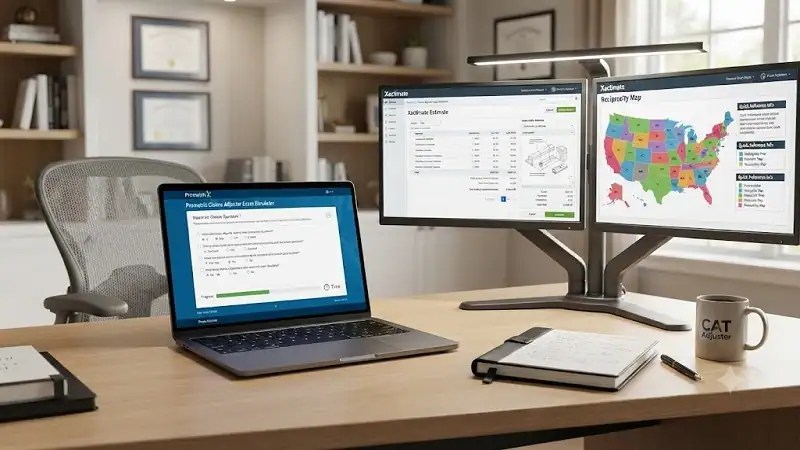
Explanation: Reciprocity streamlines multi-state licensing so adjusters can work catastrophe scenes across state lines easily. You can check out our Insurance Adjuster License Reciprocity Map for more details.
Question 49: What is “salvage value”?
A) The estimated residual value of damaged property that can be sold after a claim payout.
B) The retail price of brand-new tools.
C) Towing and storage charges.
D) Adjuster commission rates.
Correct Answer: A
Explanation: Salvage value represents what the insurer can recover by selling wrecked or damaged items.
Question 50: What is the primary role of a state insurance commissioner?
A) To sell commercial insurance policies directly to citizens.
B) To enforce state insurance laws, protect consumers, and regulate company solvency and licensing.
C) To adjust individual car accident claims.
D) To set federal tax rates.
Correct Answer: B
Explanation: The commissioner or director of insurance oversees compliance, market conduct, and licensing standards across the state.
Official Regulatory Resources and Testing Standards
Prometric manages professional examinations under strict guidelines. You can review official scheduling procedures and testing accommodations directly through the Prometric Official Website.
For state-specific licensing requirements, exam outlines, and candidate handbooks, always verify guidelines with official state portals like the Texas Department of Insurance.

Frequently Asked Questions
1. How many questions are on the Prometric claims adjuster exam?
Most state exams administered through Prometric contain between 100 and 150 multiple-choice questions. Check your specific state candidate handbook for exact testing figures.
2. What is the passing score for the adjuster licensing test?
In the vast majority of jurisdictions, candidates must achieve a minimum score of 70% to successfully pass their adjuster licensing exam.
3. Can I use a calculator during the Prometric exam?
Yes, basic math calculations involving loss settlements and depreciation are permitted. Prometric provides an on-screen calculator or allows approved basic models.
4. How soon can I retake the test if I fail on my first attempt?
Retake rules vary depending on your state. Some jurisdictions allow a re-test within a few days, while others enforce a mandatory waiting period.
5. Are practice tests similar to the real Prometric exam?
High-quality practice tests mimic the exact difficulty level, question format, and time limits to ensure you are fully prepared for test day.

Certification Research Editor at CertPrepDesk.com. Researches certification exams, licensing requirements, and study resources to help readers understand exam information through clear, practical guides based on official sources.